The short answer
Tracing letters vs writing letters isn't a contest — they're two stages of one skill. Tracing letters teaches the hand where to go. Writing letters from memory teaches the brain what a letter is. Most children need tracing first, but the mistake is staying there too long. The tracing letters vs writing letters answer is a sequence: tracing letters → copying → writing letters from memory, one letter group at a time.
Your child traces perfectly. Then they freeze on a blank page.
Every parent who has wondered about tracing letters vs writing letters has seen this exact moment.
The tracing worksheet comes back looking wonderful. Every letter sits neatly inside the dotted lines. The curves are smooth. You feel that small, proud flutter — she's got it.
Then you slide a blank sheet across the table and say, "Now write an A for me."
And she freezes. The pencil hovers. She looks at you, then at the empty paper, then back at you. Maybe she draws something almost like an A, tipped sideways. Maybe nothing at all.
Nothing has gone wrong. What happened is simpler: the practice stopped one step early. Tracing letters was doing a job — just not the job you thought.
This guide settles the tracing letters vs writing letters question properly: what each method trains, what happened when researchers put both inside an MRI scanner, and the four-stage order that moves a child from dotted lines to a blank page without frustration.
What tracing letters actually teaches (and what it doesn't)
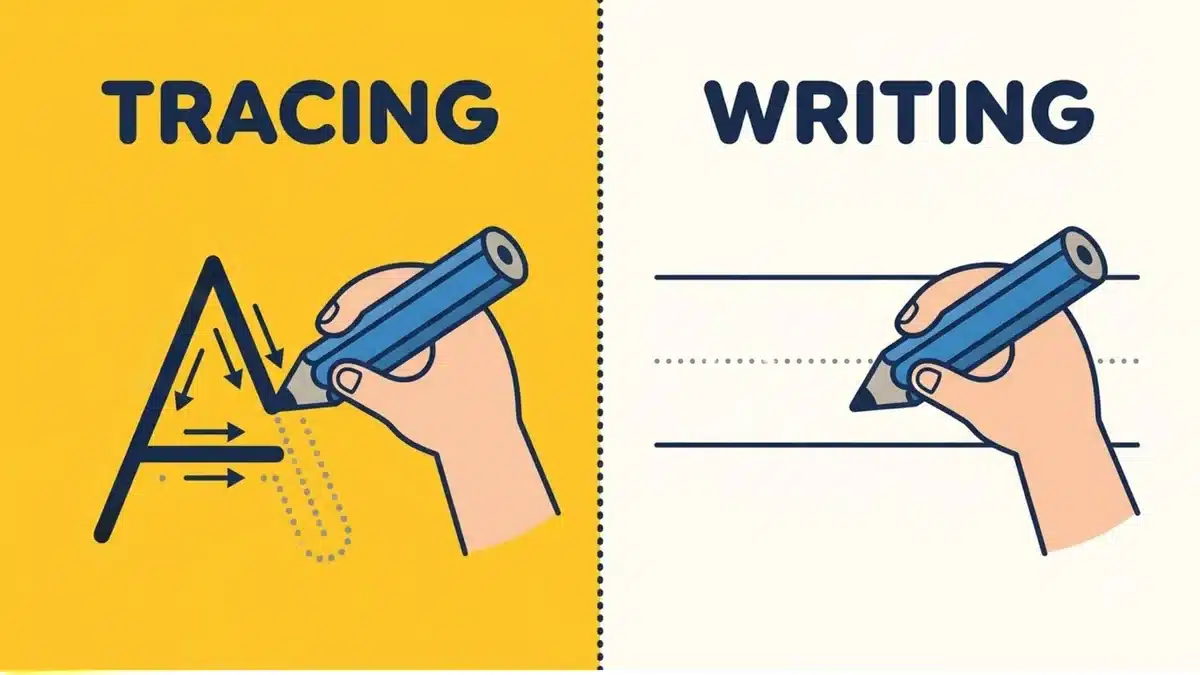
The tracing letters vs writing letters comparison starts here, with what the dots are actually for. When a child traces, the letter is already on the page. The outline does the thinking. The child follows the rail.
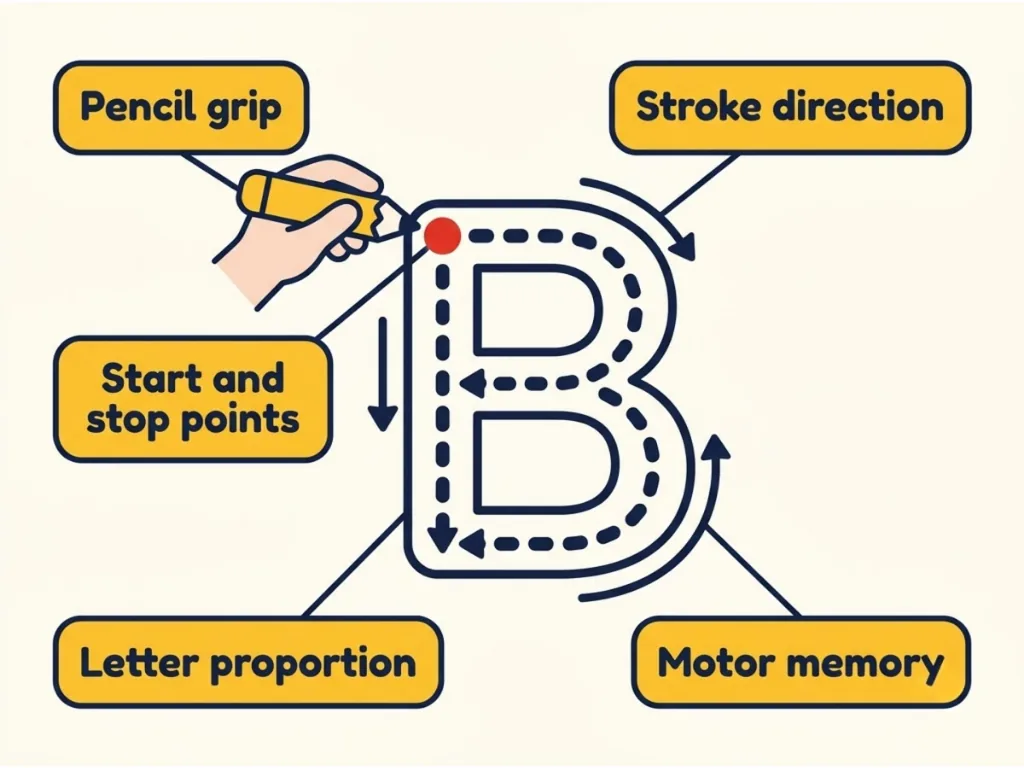
That sounds like a criticism. It isn't. Following a rail is what a three or four-year-old hand needs, because a surprising number of separate skills hide inside one letter:
- Pencil grip and hand strength — holding a tripod grip for a full row without the fingers sliding into a fist
- Stroke direction — knowing the line in a T comes down, not up
- Start and stop points — where the pencil lands and where it lifts
- Proportion — how tall the stem is against the curve
- Motor memory — the hand rehearsing one movement until it feels automatic
Tracing lets a child practise all five without also remembering what the letter looks like. That's real load reduction for a small learner, and it's why early-years classrooms start here.
Here is the part that decides tracing letters vs writing letters: tracing never asks the child to pull the shape out of their own memory. The worksheet remembers it for them.
A useful way to picture it: singing along with the radio. You sound great. You hit every word. Then the radio cuts out and you discover you only knew the chorus.
What writing letters teaches instead
In the tracing letters vs writing letters debate, "writing" doesn't mean creative writing. For a preschooler it means producing the letter without a dotted guide — copying a printed model, or writing letters from memory when you say the sound.
The moment the dots disappear, the task changes. Now the child must:
- Retrieve the shape from memory
- Plan the strokes before the pencil lands
- Judge size and spacing against a blank line
- Notice and fix mistakes mid-letter
Those are four jobs tracing quietly handled. And here's what parents find counter-intuitive: the output looks worse, and that is the point.
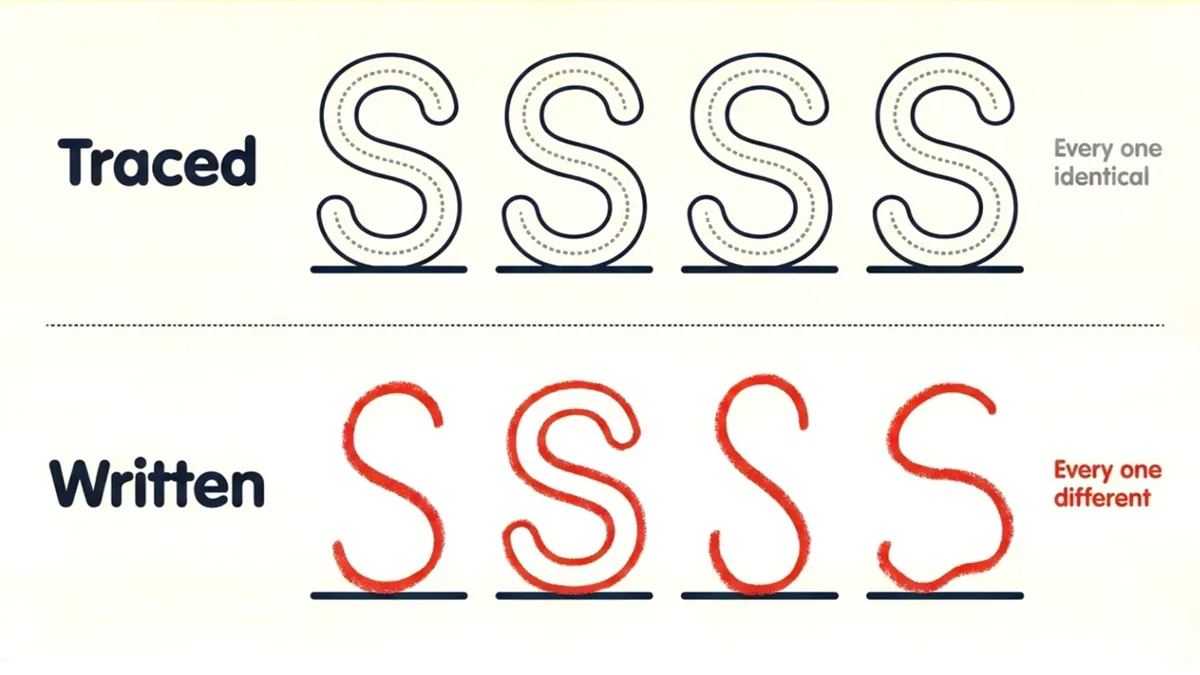
A traced S looks like every other traced S. A copied S is wobbly, too fat, leaning left. Write it three more times and you get three more versions. That variety does real work — the brain sees many messy examples of "S-ness" rather than one perfect stamp, which is far closer to how letters appear in books, on signs, and in other people's handwriting. Tracing letters vs writing letters is, at bottom, a choice between one perfect copy and many imperfect ones.
The brain research on tracing letters vs writing letters
Here the tracing letters vs writing letters comparison stops being a matter of opinion.
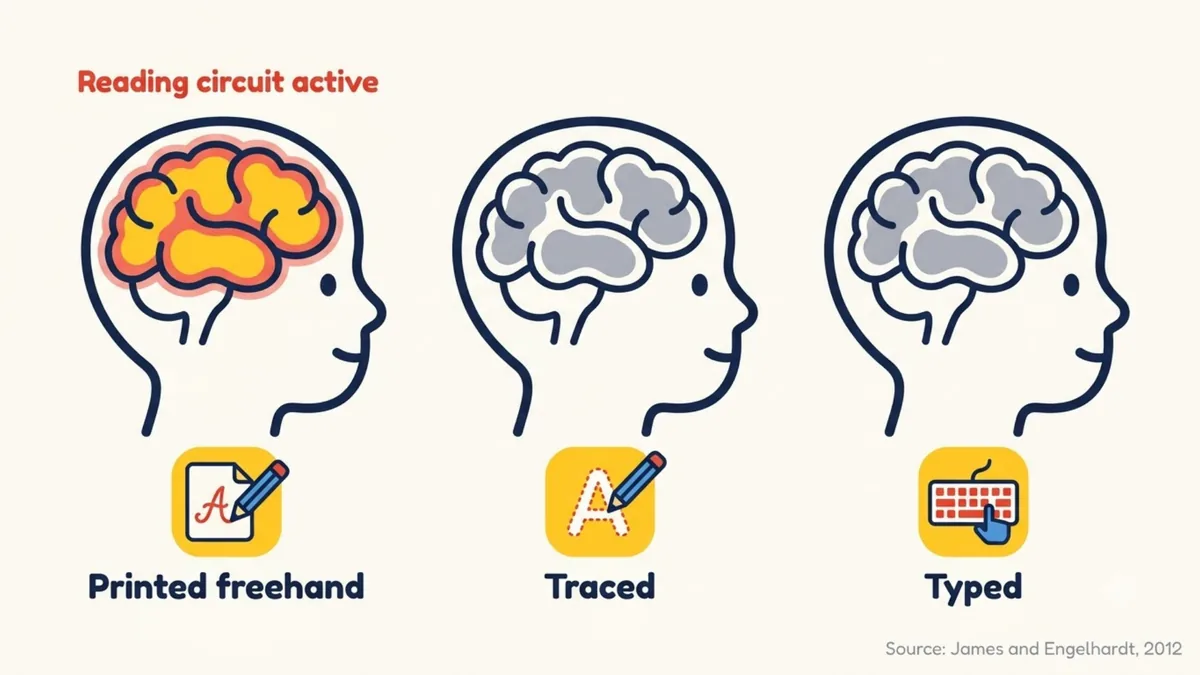
In 2012, Karin H. James and Laura Engelhardt at Indiana University ran the study still most cited on this question. Published in Trends in Neuroscience and Education, it took five-year-olds who could not yet read and had them practise letters three ways: printing freehand, tracing over a guide, or typing.
The children were then shown those letters inside a functional MRI scanner.
The researchers reported that a known "reading circuit" — the fusiform gyrus, inferior frontal gyrus and posterior parietal cortex — was recruited when children viewed letters they had printed freehand. It was not recruited the same way for letters they had only traced or typed. On tracing letters vs writing letters, that is the single most important finding to date.
A later study from the same lab, published in the Journal of Experimental Psychology: General, proposed why: copying produces variable output, while tracing produces a near-identical prototype every time. That variability may be what helps a child build a flexible category for the letter.
Three honest caveats, because this gets over-claimed online. These were small laboratory studies with short training sessions, not multi-year classroom trials. They set the three methods against each other — they did not test tracing as a stepping stone to printing, which is how it's actually used at home and in school. And brain activation measures processing, not worth: a child who traces is not damaging anything.
So the fair reading of tracing letters vs writing letters isn't "tracing is bad." It's this: tracing letters is the on-ramp, not the destination. The reading benefit arrives when the child starts producing letters themselves.
Tracing letters vs writing letters: side-by-side
Set tracing letters vs writing letters against the same eight criteria and the pattern is hard to miss.
| Tracing letters | Writing letters | |
|---|---|---|
| What the child does | Follows a dotted path | Produces the letter themselves |
| Main skill built | Pencil control, stroke order, muscle memory | Letter recall, planning, self-correction |
| Cognitive load | Low — the shape is given | High — the shape must be retrieved |
| Typical starting age | 3 to 4.5 years | 4.5 to 6 years |
| What it looks like | Neat, uniform | Wobbly, uneven, varied |
| Biggest benefit | Builds confidence fast, low frustration | Strongest link to letter recognition and reading |
| Biggest risk | Child goes on autopilot and stops looking | Started too early, causes frustration and refusal |
| Best used for | Introducing a brand-new letter | Consolidating a letter the child already knows |
Laid out like this, the answer is obvious. Tracing letters vs writing letters isn't a fight over the same slot in your child's week. They're competing for different weeks in the same letter's journey.
The four-stage ladder (and the rung everyone skips)
Handwriting doesn't jump from nothing to writing. It climbs. Tracing letters vs writing letters describes two rungs of this ladder, not two rival methods. Here's the full order, with the rough ages pediatric occupational therapists use as a guide — guides, not deadlines.
-
Pre-writing lines and shapes
Around 2.5 to 4 years
Before letters, the hand learns nine strokes, roughly in this order: vertical line, horizontal line, circle, cross, square, left diagonal, right diagonal, X, triangle. Simple strokes first; diagonals and the triangle last, because they demand the most control. These aren't warm-ups — they're the parts letters are made of. A capital A is two diagonals and a horizontal. A B is a vertical line and two curves.
-
Guided tracing letters
Around 3.5 to 5 years
Dotted letters with a clear starting dot and directional arrows. Large size first, smaller later. Uppercase before lowercase, because uppercase letters are built from straight lines and simple curves.
-
Copying from a model
Around 4.5 to 6 years
A finished letter sits at the top of the line. Below it, the line is empty. The child looks up, then writes.
This is the rung most home practice skips — families jump straight from tracing letters to a blank page, and the gap is too wide.
-
Writing letters from memory
Around 5 to 7 years
You say "write the letter that starts mango." No model, no dots. This stage is what proves the letter is learned.
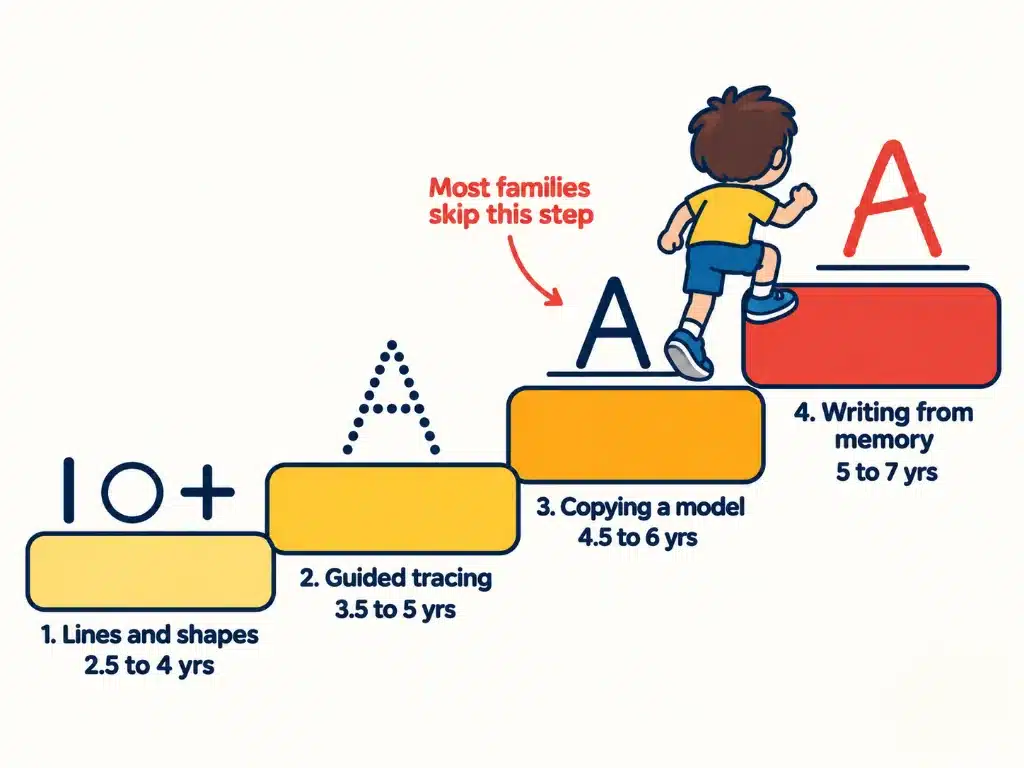
A useful rule: a child sits on different rungs for different letters at once. O, L and T might be at Stage 4 while G, S and Q are still at Stage 2. On tracing letters vs writing letters, the honest answer is usually "both this week, depending on the letter." Don't hold the easy letters back waiting for the hard ones.
Five signs your child is ready to stop tracing letters
These are the signals that settle tracing letters vs writing letters for your particular child. Look for them during ordinary practice, not during a test.
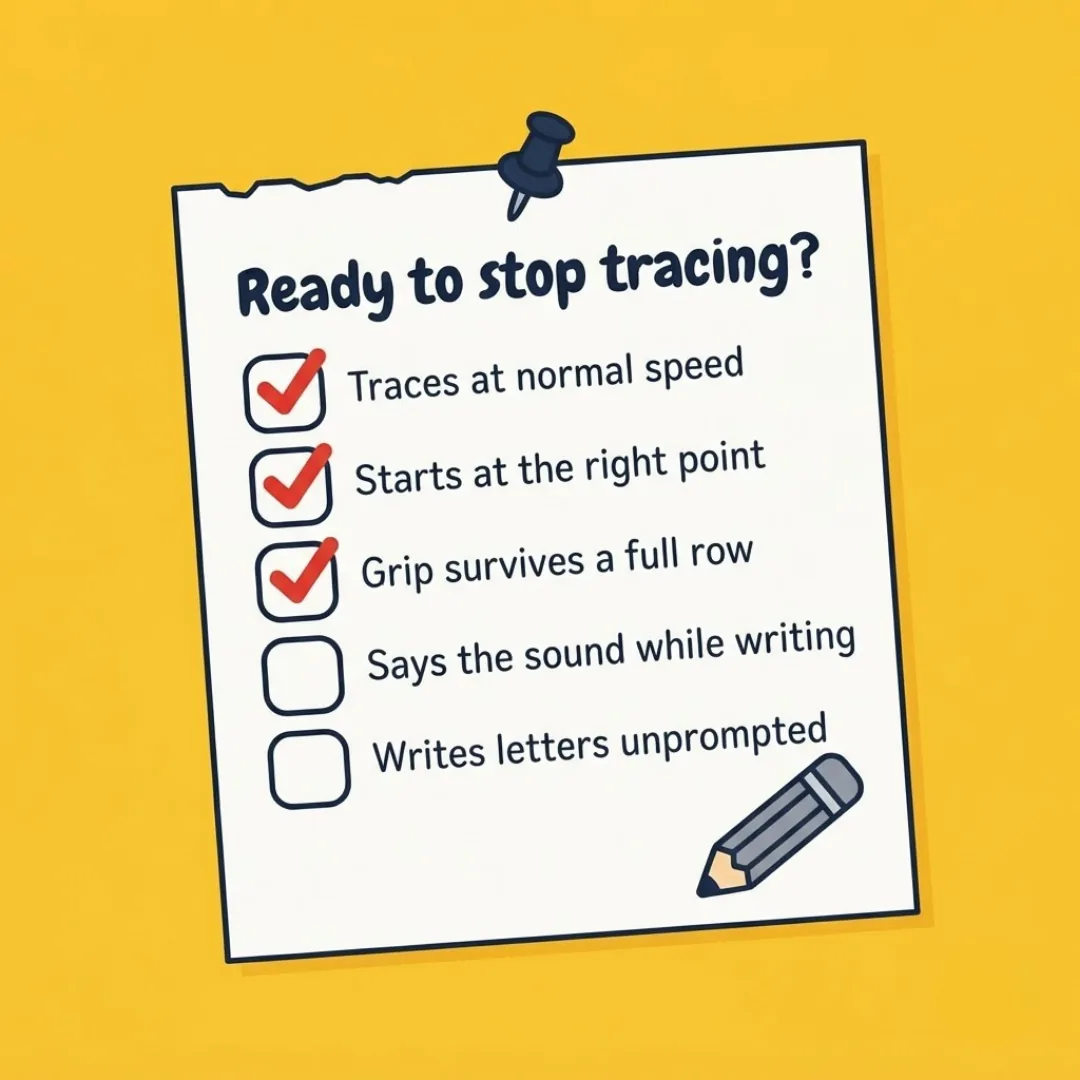
- They trace at normal speed without slowing at corners. Hesitation at a curve means the hand is still working it out.
- They start at the right point without a reminder. Starting a 5 or an E from the bottom is the clearest sign a letter isn't consolidated.
- Their grip survives a full row. If the fingers creep into a fist by the fourth letter, the hand needs strength work, not more letters.
- They say the letter's name or sound while writing it. Linking shape to sound is what makes practice count for reading.
- They write letters when nobody asked — on a foggy window, in spilled flour, at the bottom of your shopping list. This is the big one. Spontaneous writing means the letter lives in their head now.
Three or more? Stop tracing letters for that letter and move to a blank line.
The fade-out routine: 10 minutes a day, one week per letter group
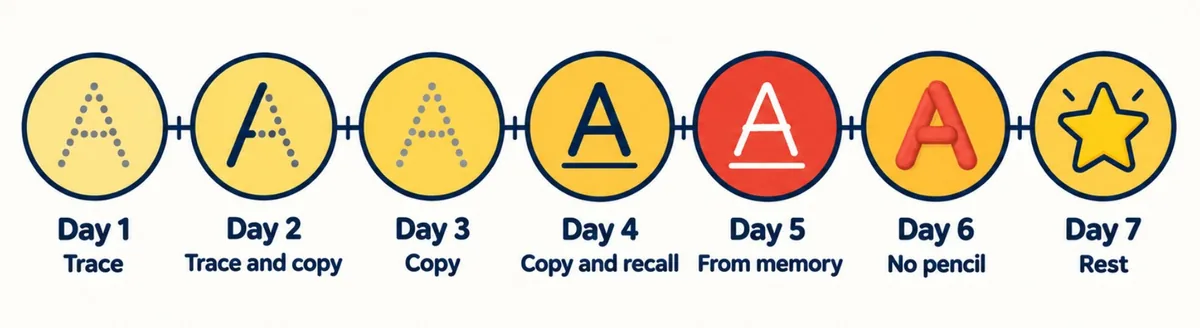
You don't switch methods overnight. You fade the support out, so tracing letters vs writing letters becomes a handover rather than a cliff edge. Here's a week that works for most 4 to 6-year-olds, using three or four letters at a time.
| Day | Activity | Why |
|---|---|---|
| Day 1 | Trace each letter 4 times, large, saying the sound aloud | Introduce the path |
| Day 2 | Trace 2, then copy 2 from a model | First taste of producing it |
| Day 3 | Copy all 4 from a model at the top of the page | The skipped rung |
| Day 4 | Copy 2, then write 2 from dictation | Testing recall gently |
| Day 5 | Write all 4 from dictation — big and messy is fine | Full retrieval |
| Day 6 | No pencil: build letters in sand, playdough or sticks | Rest the hand, keep the shape |
| Day 7 | Rest, or let the child write anything they want | Ownership |
Three ground rules matter more than the schedule:
- Stop at 10 minutes, even if it's going well. Ending on a good note beats one extra row.
- Three to four letters per week, maximum. For a three-year-old, two.
- Never re-do a letter because it looks untidy. Re-do it only if the strokes were wrong — wrong start, wrong direction. Neatness arrives on its own once the movement is right.
Five mistakes that keep children stuck on tracing letters
Each of these keeps a family frozen on one side of tracing letters vs writing letters for months longer than necessary.
1. Twenty repetitions of the same letter in one sitting
After the fourth repeat most children switch to autopilot — the hand keeps moving and the eyes stop looking. Four good repeats beat twenty absent ones.
2. Starting letters before the pre-writing shapes are solid
If your child can't copy a cross or a square yet, tracing will feel like climbing a wall. Go back to lines and shapes for a few weeks. It's faster in the end.
3. Correcting how it looks instead of how it was made
"Make it neater" gives a child nothing to act on. "Start at the top and pull straight down" does.
4. Living in uppercase forever
Uppercase is the right start, but books are mostly lowercase. Once your child is confident with uppercase, bring lowercase in alongside it rather than waiting for uppercase to be perfect.
5. Never removing the dots
This is the big one, and it's almost always accidental. Tracing letters is satisfying — worksheets come back neat, the child feels successful, everyone's happy. So the family stays there for months. Set a reminder: every letter gets a dot-free attempt within two weeks of being introduced.
Free worksheets for every stage
Every stage above has matching printables on Kidzolearn — free, no login, no payment. Whichever side of tracing letters vs writing letters your child is on today, there's a sheet for it.
Start with one letter group this week. Print, set a 10-minute timer, and let the wobbly letters happen.
Browse alphabet worksheetsQuestions parents ask
Tracing letters vs writing letters: which is better for kids?
Neither, on its own. Tracing letters is better for introducing a brand-new letter, because it removes the memory load and lets the hand rehearse the movement. Writing letters is better for consolidating a letter the child already recognises, because it forces recall. On tracing letters vs writing letters the research favours writing — but only once the child can already form the shape. Use tracing first, then switch.
Is tracing letters bad for my child?
No. Tracing letters builds pencil control, correct stroke order and confidence, and it's the right place for most children to start. The finding behind the tracing letters vs writing letters headlines is narrower than it sounds: tracing alone didn't activate the reading circuit the way freehand printing did. Treat it as the first rung of the ladder, not the whole ladder.
At what age should a child stop tracing letters and start writing them?
There's no fixed age — it depends on the letter, not the birthday. Most children begin copying from a model between 4.5 and 6 years, and write from memory between 5 and 7. Use the five readiness signs above rather than the calendar, and expect tracing letters vs writing letters to have a different answer for different letters in the same week.
Should we start with uppercase or lowercase letters?
Uppercase first. Uppercase letters are straight lines and simple curves, which sit closer to the pre-writing shapes a child already knows. Lowercase needs more curves, closed loops and lines dropping below the baseline. Bring lowercase in alongside uppercase once your child is comfortable, not after uppercase is flawless.
How long should handwriting practice last each day?
Ten minutes is plenty for a 4 to 6-year-old, five for a three-year-old. Short daily practice beats a long weekend session. Stop while the child is still enjoying it.
My child writes letters backwards. Should I worry?
Letter reversals — b for d, a backwards S — are normal up to around age seven. They show the brain still sorting out direction, not a learning difficulty. Keep practising with a clear starting dot and reversals usually fade on their own. If they persist well past seven alongside other reading struggles, mention it to your child's teacher.
Can tablet tracing apps replace paper worksheets?
They help with letter recognition and they're convenient, but a finger on glass doesn't build the grip strength, pencil pressure control or hand endurance a crayon on paper does. Use apps as a supplement. Note too that the research compared paper printing with tracing and typing — tablet apps were not part of the tracing letters vs writing letters studies at all.
Does the tracing letters vs writing letters answer change for left-handed children?
The sequence stays the same, but two practical things help. Tilt the paper clockwise so the hand sits below the writing line rather than dragging across it, and check the starting dot is visible from the left side. Left-handed children often stay on tracing letters slightly longer because they're also solving a hand-position problem at the same time. That's not a delay worth worrying about.
Tracing letters vs writing letters: the short version
Tracing letters isn't the opposite of writing letters. It's the first draft of it.
Give your child dotted lines when a letter is brand new — that's what the dots are for. Then take them away, in small steps, within a couple of weeks. Let the letters come out wobbly. Let the S lean. That crooked, self-made, nobody-helped-me S is worth more than a page of perfect traced ones, because your child built it from the inside.
Tracing letters vs writing letters was never a choice between two methods. It's a question of when, and the answer is: sooner than most families think.
Sources
- James, K. H., & Engelhardt, L. (2012). The effects of handwriting experience on functional brain development in pre-literate children. Trends in Neuroscience and Education, 1(1), 32–42. — ScienceDirect · Full text PDF, Indiana University
- Li, J. X., & James, K. H. (2016). Handwriting generates variable visual output to facilitate symbol learning. Journal of Experimental Psychology: General. — PDF via the American Psychological Association
- Longcamp, M., Zerbato-Poudou, M.-T., & Velay, J.-L. (2005). The influence of writing practice on letter recognition in preschool children: a comparison between handwriting and typing. Acta Psychologica, 119(1), 67–79.
- Pre-writing stroke developmental sequence — North Shore Pediatric Therapy: Developmental Milestones for Pre-Writing and Writing Skills
Great content! Keep up the good work!